If your child has been referred for a bronchoscopy, you are probably feeling anxious. The word sounds serious. In reality, flexible bronchoscopy in children is a safe, well-tolerated, and extraordinarily useful investigation, and in experienced hands, it carries very low risk.
I have performed hundreds of pediatric bronchoscopies over my career, first at Royal Manchester Children's Hospital, where I led the bronchoscopy service, and since 2021 in Dubai. Let me explain exactly what it involves.
What is flexible bronchoscopy?
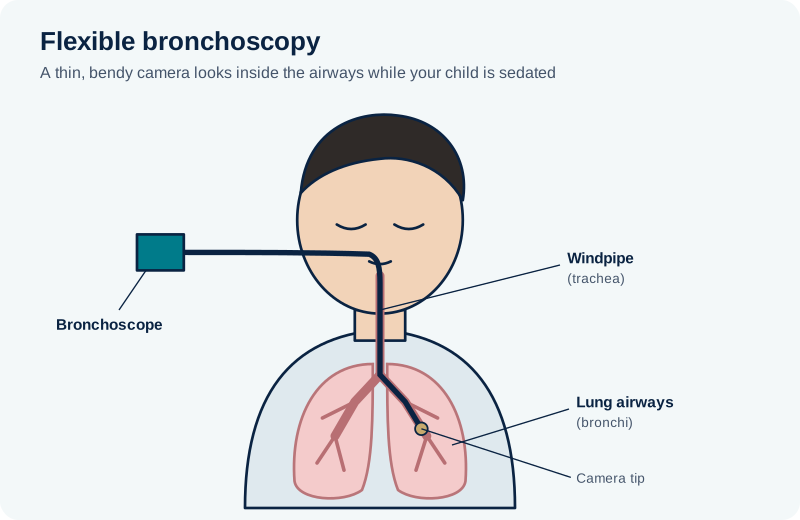
A flexible bronchoscope is a thin, flexible tube, about the width of a pen, with a camera and light at the tip. It is passed through the nose or mouth, through the vocal cords, into the trachea (windpipe), and down into the bronchi (the airways of each lung). The camera transmits real-time images, allowing me to directly visualise the entire airway from the nose to the smallest bronchi accessible.
It is done under conscious sedation, your child is sleepy and comfortable but not fully anesthetised. They breathe throughout the procedure. Most children have no memory of it afterwards.
Why might a child need bronchoscopy?
The most common reasons I recommend bronchoscopy in my practice:
- Persistent wheeze or stridor not responding to treatment, to directly assess the airway for structural abnormalities such as tracheomalacia, subglottic stenosis, or airway compression
- Recurrent pneumonia in the same part of the lung, to look for a fixed obstruction such as an inhaled foreign body, mucus plug, or an airway abnormality
- Persistent wet cough not responding to antibiotics, bronchoalveolar lavage (BAL) allows me to sample fluid from deep in the lung, identifying the infecting bacteria and guiding targeted antibiotic treatment
- Suspected foreign body inhalation, bronchoscopy is both diagnostic and therapeutic; I can remove the foreign body under direct vision
- Unexplained collapse of part of the lung (atelectasis), to identify the cause and, if possible, clear the obstruction
- Ciliary sampling for PCD (Primary Ciliary Dyskinesia), brushings from the nasal or bronchial epithelium for electron microscopy and ciliary beat pattern analysis
- Assessing the airway in complex patients, children on long-term ventilation, those with tracheomalacia, or those with unexplained breathing difficulties
EBUS-TBNA: a more advanced bronchoscopic technique
I was one of the first pediatric physicians to perform EBUS-TBNA (endobronchial ultrasound-guided transbronchial needle aspiration) in pediatric patients, a technique more commonly used in adult thoracic medicine. It allows sampling of lymph nodes around the central airways using a needle passed through the bronchoscope, guided by ultrasound in real time.
This is used for investigating enlarged chest lymph nodes, for example, to diagnose tuberculosis, lymphoma, or sarcoidosis, without the need for open surgery.
What does the procedure involve?
- Preparation, your child will need to fast for a period beforehand (I will give you specific instructions). A nurse will prepare them and explain what to expect in child-friendly terms.
- Sedation, a combination of sedative and local anesthetic spray to the throat. Your child will be monitored throughout with pulse oximetry, heart rate, and blood pressure monitoring.
- The procedure, usually takes 10 to 20 minutes. Your child lies on their back. The bronchoscope is passed and I systematically examine the airway, collecting samples as needed.
- Recovery, your child will rest in recovery for 30 to 60 minutes until the sedation has worn off. They may have a slightly sore throat or hoarse voice for a day or two.
- Results, BAL cultures take 24–72 hours. Other results (biopsies, ciliary analysis) take longer. I will discuss all findings with you in full.
Flexible bronchoscopy in children has an excellent safety record in experienced hands. Serious complications are rare. The most common side effects are a temporary sore throat, mild fever, or brief low oxygen readings during the procedure, all managed immediately by the team. I perform these procedures with a dedicated pediatric team and full monitoring throughout.
Clinical references
- Kantar A, Chang AB, Shields MD, et al. ERS statement on protracted bacterial bronchitis in children, including bronchoalveolar lavage findings. Eur Respir J 2017;50:1602139. View source
Frequently asked questions
Is bronchoscopy safe for children?
Will my child be awake during a bronchoscopy?
How long does a child take to recover from bronchoscopy?