Asthma is the most common chronic disease in childhood worldwide, and in Dubai, the combination of desert dust, air conditioning, and high allergen exposure means it is particularly prevalent. Yet it remains one of the most commonly misdiagnosed and undertreated conditions I see in clinic.
The good news: with the right diagnosis and management plan, the vast majority of children with asthma live full, active lives with minimal disruption.
What is asthma?
Asthma is a condition in which the airways become inflamed, narrowed, and oversensitive to certain triggers. During an asthma episode, the lining of the airways swells, the muscles around them tighten, and extra mucus is produced, making it harder to breathe. Between episodes, many children feel completely well.
It is a chronic inflammatory condition, not just occasional breathlessness. This distinction matters because it means asthma requires ongoing management, not just treatment when symptoms flare.
How asthma presents in children: it is not always obvious
Parents often picture asthma as a child gasping for breath. In reality, many children with asthma have subtler, easily overlooked symptoms:
- Persistent cough, especially at night, in the early morning, or after exercise. Many children with cough-variant asthma are treated for infections for months before the correct diagnosis is made.
- Wheeze, a whistling sound when breathing out, caused by narrowed airways
- Chest tightness, younger children often describe this as a "funny feeling" in the chest
- Breathlessness on exertion, struggling to keep up in PE, stopping to rest during play
- Recurring "chest infections", if your child has had three or more chest infections requiring antibiotics, asthma should be considered
Common triggers in Dubai and the UAE
In my practice here, the following triggers come up repeatedly:
- House dust mites, thrive in warm, air-conditioned environments. One of the leading triggers in Dubai households.
- Sand and dust, particularly during shamal winds and construction activity
- Air conditioning, cold, dry air directly irritates hypersensitive airways
- Mould spores, in older buildings or poorly ventilated rooms
- Shisha smoke and cigarette smoke, significant airway irritants; even secondhand exposure matters
- Viral respiratory infections, RSV, rhinovirus, and influenza are the most common triggers of acute asthma in children under five
- Exercise, particularly in cold or dry air; often the only trigger in older children with otherwise mild disease
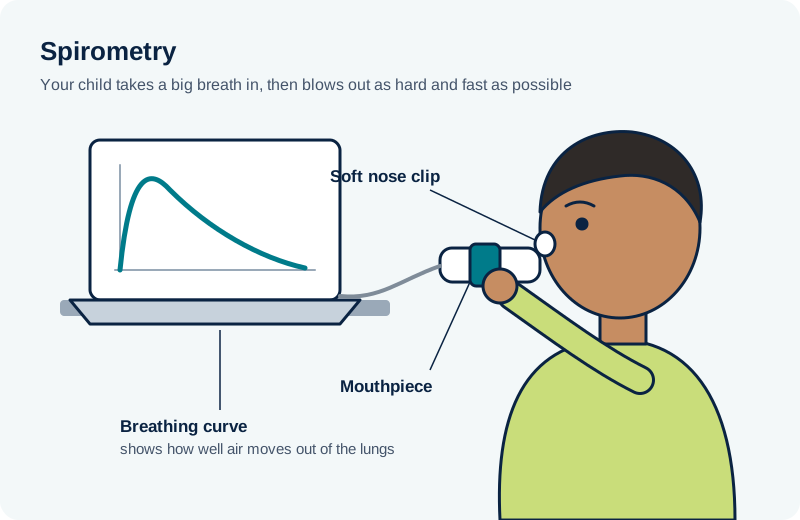
How is asthma diagnosed?
In children over five, asthma can be confirmed with objective tests. In younger children, the diagnosis is often made on clinical grounds, the pattern of symptoms, response to treatment, and family history.
Investigations I use include:
- Spirometry, a breathing test that measures how fast and how much air the child can breathe out. Characteristic obstruction that reverses after a bronchodilator is diagnostic.
- FeNO (fractional exhaled nitric oxide), a non-invasive test that measures airway inflammation. High FeNO strongly suggests eosinophilic (allergic) airway inflammation and predicts steroid responsiveness.
- Allergy testing, skin prick testing or blood tests (specific IgE) to identify allergic triggers including house dust mite, grass pollen, and animal dander.
- Peak flow diary, recording peak flow measurements twice daily for two to four weeks can reveal the variability characteristic of asthma.
Asthma is both over-diagnosed (children with viral wheeze given long-term inhalers they do not need) and under-diagnosed (children with persistent cough or exercise intolerance whose asthma is missed). Objective testing matters, a FeNO result and spirometry together give far more useful information than symptoms alone.
Management: what good asthma control looks like
The goal of treatment is not just to prevent acute attacks, it is to achieve a level of control where your child:
- Has no daytime symptoms more than twice a week
- Is not woken by asthma at night
- Is not limited in exercise or normal activities
- Needs their reliever inhaler (blue inhaler) no more than twice a week
Treatment follows a stepwise approach guided by GINA (Global Initiative for Asthma) guidelines:
- Reliever inhaler (SABA), short-acting bronchodilator for acute symptoms. Used as needed; not a substitute for preventer treatment.
- Preventer inhaler (ICS), inhaled corticosteroid taken daily. The cornerstone of asthma management. Safe at standard doses, parental concerns about steroids are understandable but the risk of uncontrolled asthma is far greater than the risk of low-dose inhaled steroids.
- Combination inhalers, ICS plus long-acting bronchodilator for children with moderate-to-severe disease or inadequate control on ICS alone.
- Biologics, for severe allergic or eosinophilic asthma unresponsive to standard therapy. I have expertise in prescribing and monitoring these agents in children.
Inhaler technique is at least as important as the choice of inhaler. A child using the wrong technique will get minimal benefit from even the best medication. I spend time at every consultation reviewing technique and ensuring the child and parents are confident.
When to seek urgent help
- Is struggling to complete a sentence due to breathlessness
- Has blue lips or fingertips
- Is not improving after repeated doses of the reliever inhaler
- Has fast breathing and ribs visible when breathing in (recession)
- Is drowsy or unusually quiet during a breathing episode
Annual influenza vaccination
Flu vaccination is part of asthma management, not an optional extra. Influenza is one of the commonest triggers of a severe asthma attack in children, and one of the commonest reasons an asthmatic child ends up admitted.
It is recommended annually from six months of age. Children under nine receiving it for the first time need two doses four weeks apart. A single dose leaves them only partly protected, and this is the step most often missed. The vaccine will not always prevent infection, but it reduces severity, which is what matters in a child with reactive airways.
Watch this video on Instagram
Dr Omi Narayan on the flu vaccine — what I tell parents in clinic
Related reading: Recurrent chest infections in children and allergic cough in Dubai children.
Clinical references
- Morice AH, Millqvist E, Bieksiene K, et al. ERS guidelines on the diagnosis and treatment of chronic cough in adults and children, including cough-variant asthma. Eur Respir J 2020;55:1901136. View source
- Asthma + Lung UK. Inhaler technique videos, endorsed by the UK Inhaler Group. View source
Frequently asked questions
How is asthma diagnosed in children?
Can a child have asthma without wheezing?
What triggers childhood asthma in Dubai?